

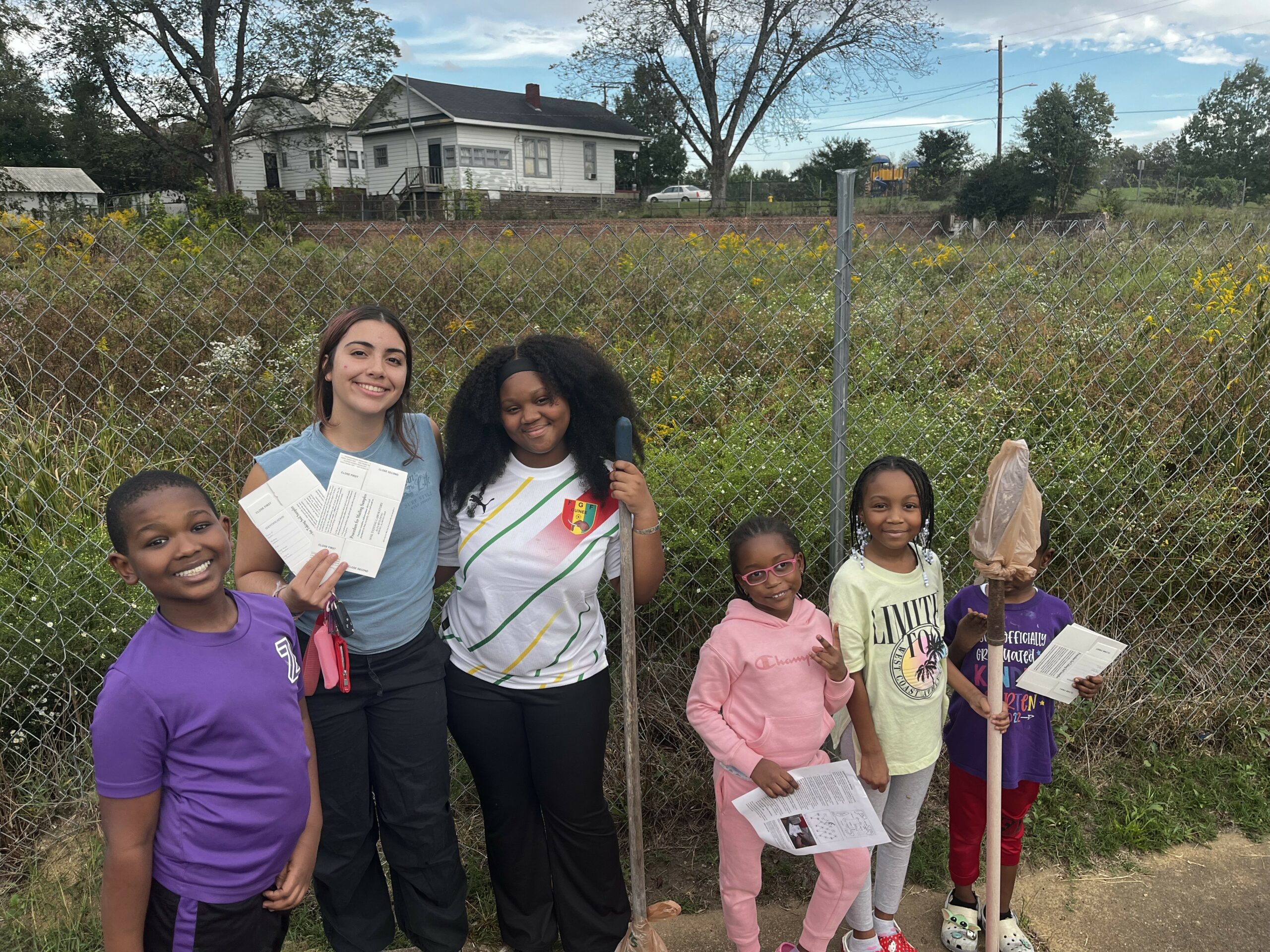
C&S Carnegie Young Leader Sofia Nunez and her team set out to start a free community garden in Birmingham to increase food access, turn an overgrown lot into a useful space, and bring neighbors together. The project did not go according to plan. It became bigger, more complicated, and more meaningful than Sofia expected.
As told by Sofia Nunez:
Where We Come From
This whole thing started after a friend and I came out of a youth leadership program and wanted to do something big.
She said, “I live in a space that needs a community garden.”
So we looked. What we found was a neighborhood that used to be predominantly white in the 1950s—middle class, upper class—and then everyone left. The sidewalks are still there. The park spaces are still there. But they’re overgrown.
Once-beautiful buildings with wonderful architecture are either falling down or already demolished. There are no third spaces. Very little food access.
But it’s still walkable. And that matters.
We started to see how a garden could create a place for people to gather, grow food, and build on what was already there.
The “Hood Humanitarian” Who Expanded Our Project
He calls himself the “hood humanitarian.” In any other neighborhood, he’d probably be the mayor.
He goes around mowing overgrown lots for free. When we tracked him down at a neighborhood association meeting, we told him the idea.
He said, “We can make it happen tomorrow. I can mow the lawn, talk to city council, get you the land, get you through the whole process. You’ll have it by next week.”
Spoiler: We did not have it by next week.
But he knew who to talk to. He knew how to make things happen. He’d just never had enough push behind him for it to actually happen.
And once we gave him that push, he ran with his vision—not ours.
He wanted to connect the school. Add a kitchen. Make it a fully functional intergenerational space.
Which is a great idea. It’s just not what two high schoolers were planning when we thought we’d maintain two or three vegetable plots.
Our small project became something with multiple stakeholders, a school program, a kitchen—and we’re still trying to get the land.
That was one of the first things we had to learn: Once other people become part of a project, it isn’t just your idea anymore.
The Red Tape Nobody Warns You About
Here’s what I’ve learned about city bureaucracy that I wish someone had told me: Even the cheap option is complicated.
Our city has a land bank. It takes over properties when owners stop paying taxes and eventually makes some of them available to new owners or community groups. You can lease one for two years for just $100.
That sounded perfect.
Except our target property was formerly owned by Wylam Baptist Inc., a nonprofit church. Because the church did not pay taxes, the property technically does not qualify for the normal land-leasing process.
The only way around it is through government channels. Our sponsor from a nearby church has a connection to a city council member, so we had to wait to catch that council member at the right time.
In the meantime, I decided to trespass.
We went out one night with weed whackers into this overgrown plot, mowing stuff down and trying to gather soil samples to see if the land was polluted.
The people at the church nearby saw us. They were yelling, “Hey, hey, what’s up?”
We just kept going.
It was not necessarily our best decision. But we were impatient. We wanted to know whether the ground was safe, and we wanted to feel like the project was moving.
The whole experience taught me that caring about a place does not mean you get to skip the work of earning trust, getting permission, and figuring out how the system works.
The Goal Got Smaller, But The Commitment Got Bigger
I’ve always been a dreamer. But there’s a difference between being taught how to be a leader and actually being allowed to be one.
I’ve been in programs my whole life that teach you the right practices, how to speak, and how to build support. But I had never been in a space where I was allowed to just do it.
I had to show up to neighborhood association meetings where I was the only kid and people looked at me like, “Do you even live here?”
And I had to say, “No, but I’m here anyway, and I want to talk to you.”
I also had to override my own internalized fear about going into Wylam—the kind of low-key suburban warning that gets passed around about certain neighborhoods—and realize that fear wasn’t mine.
It was learned. And it was wrong.
I’ve shifted the project’s end goal, too.
It’s not monthly festivals and big programming. It’s a spring garden. A few plots. Seventy-five people. Enough produce to donate to the food bank next door. Maybe a connection to the elementary school.
The goal got smaller. But my commitment got bigger.
I’m not doing this for a year anymore. I’m doing it until I leave Birmingham.
Because it actually matters to me now.
That wasn’t the plan. But here we are.