


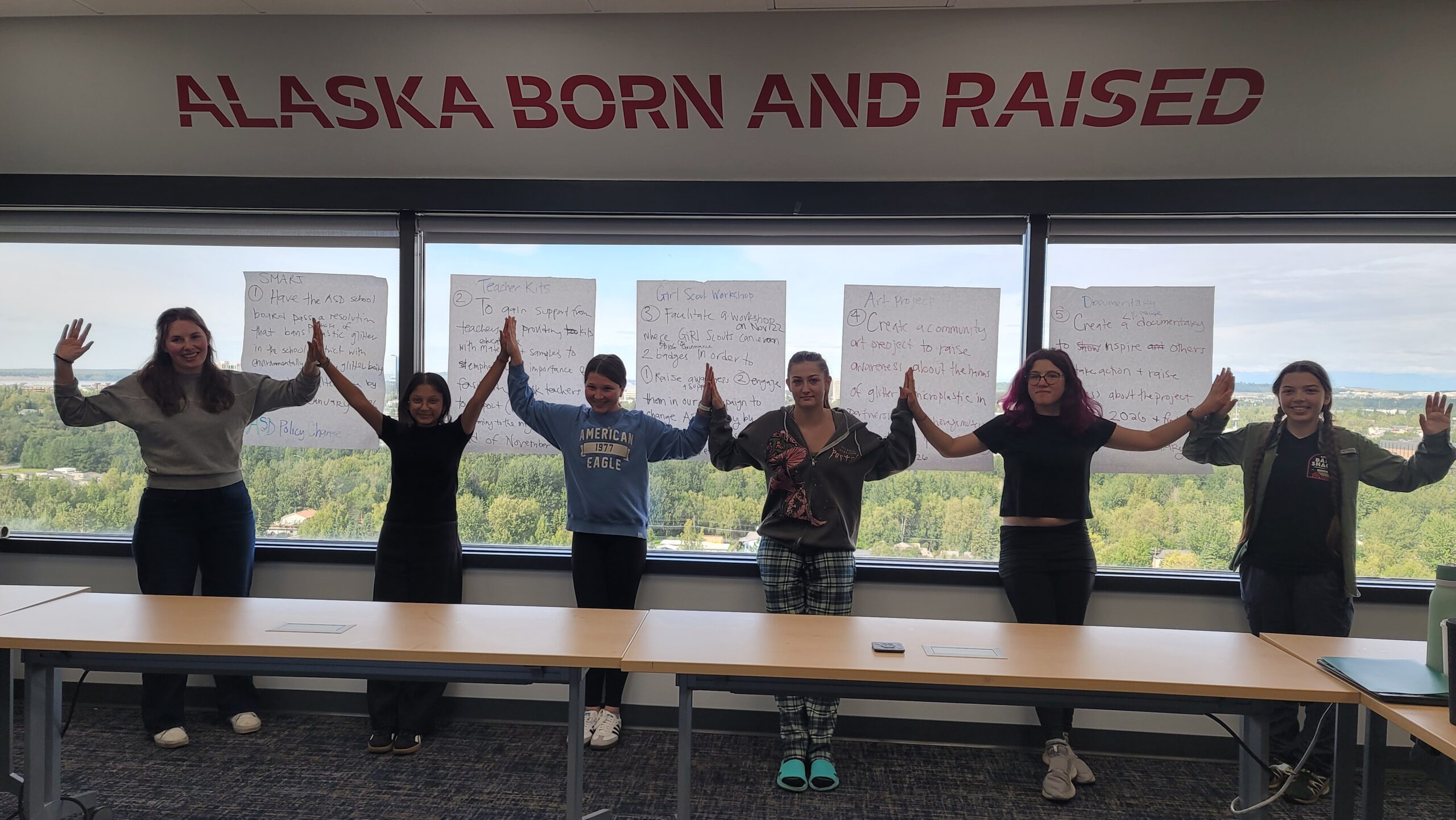
C&S Carnegie Young Leader Emily Brubaker and her Girl Scout troop led a successful campaign to replace plastic glitter in Anchorage classrooms with biodegradable alternatives. Their resolution passed unanimously and has the potential to affect 43,000 students.
Here’s how they did it, as told by Emily Brubaker:
Finding Adult Allies
We first connected with Anchorage School Board Member Kelly Lessens and key district leaders to explore bringing biodegradable glitter into Anchorage schools.
After extensive outreach—including emailing more than 30 principals—we gathered enough verified signatures to present our resolution to the Student Advisory Board.
We also reached more than 80 participants at a Girl Scouts event through biodegradable glitter face painting and were invited to present our teacher kits at the district’s art teacher in-service days.
I even published a children’s book, All That Glitters Is Not Gold, to help raise awareness about glitter pollution.
We wanted to show that youth can lead the change.
Bureaucracy Couldn’t Stop Us
One major hurdle emerged during the petition campaign.
We discovered that the Student Advisory Board only accepts petitions submitted through a district-managed online form. We had already gathered dozens of paper signatures, but none of them counted toward the official total.
The district’s form also required students to log in through their school Gmail accounts and verify their signatures with a second, non-school email. Many students could not access those accounts during the school day because of device and email restrictions.
In practice, only about one in three students could complete the verification successfully.
Rather than give up, we problem-solved creatively. We continued collecting signatures through the official system while encouraging individual schools to pass their own resolutions of support.
The process became a real-world lesson in persistence, navigating policy, and finding another path when the first one does not work.
Leadership is a Team Sport
I have learned that teamwork is so much more effective than working alone.
There are seven members of the BioGlitter Initiative, each working on a separate part of the project and bringing it together around our collective goals.
Working with these amazing people has taught me that working alone is definitely not the way to get things done. If you want to be time-efficient, effective, and have a large and lasting impact, a team of hardworking, passionate people is the way to do it.
That teamwork carried us through months of outreach, presentations, workshops, signature gathering, and meetings with elected officials.
In December 2025, we presented our resolution to the Anchorage School Board.
It passed unanimously.
The resolution has the potential to affect 43,000 students across the district—and replace a small source of plastic pollution with a safer alternative.
How We Got There
- October 23: Presented to elementary school art teachers at a district in-service meeting.
- November 11: Presented to secondary school art teachers at a district in-service meeting.
- November 18: Presented the BioGlitter Resolution to the Student Advisory Board.
- November 22: Hosted the Glitter, Gala, and Governance Workshop and Democracy Panel, attended by five elected officials and 100 young people.
- November 28: Staffed a booth at the Anchorage Museum’s Crafted in Alaska Fair.
- December: Delivered children’s books to classrooms and collected letters of support.
- December 16: Presented the resolution to the Anchorage School Board, where it passed unanimously.
Impact Snapshot
- More than 200 community participants
- 31 principals contacted
- One student leadership class presentation
- One district-level petition approved for presentation to the Student Advisory Board
- One children’s book published
- One governance workshop with five elected officials
- Two district art teacher presentations
- One resolution passed to ban plastic glitter in the Anchorage School District