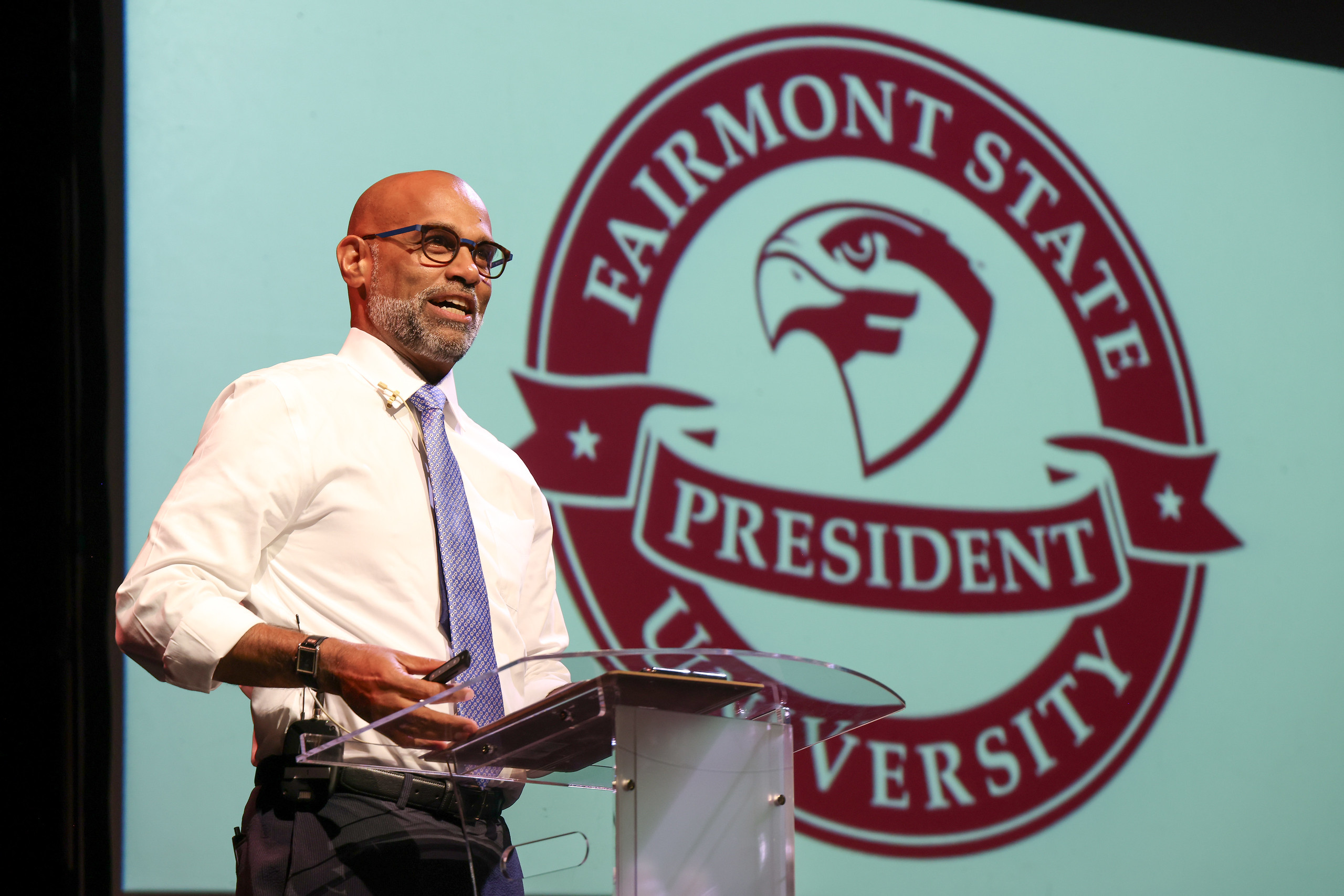


C&S President Raj Vinnakota delivered the 2026 commencement address at Muhlenberg College, challenging graduates to resist becoming spectators to their own lives and instead choose participation, community, and civic responsibility. Read the full transcript of his remarks below.
I remember sitting in your seat on my own graduation day. Looking around at my friends. Smiling. Taking photos. Publicly celebrating and privately wondering whether any of us actually had any idea what we were about to be doing.
I bet some of you know exactly what I mean.
Before you worry too much about tomorrow, I want you to notice something about today.
Today may be the last time you’ll be surrounded by this many people who are different from you. People who came from different backgrounds, had different life experiences, and see the world differently than you do.
Tomorrow, everyone scatters into completely separate lives. And over time, your world may get smaller in ways you don’t notice at first. The people around you begin to look more like you, think more like you, and experience the world more like you do.
What makes a place like Muhlenberg so special is not just what you learned here. It’s who you learned it with.
The real test after graduation is whether you continue to build community with people who are not exactly like you.
At my college graduation, my generation was told something very different. My generation was told to:
Stand out.
Be the entrepreneur.
Be the star.
And, some of that advice was good. Some of it inspired me.
It was part of the motivation to launch the first SEED School, a public boarding school for students who hadn’t been given the opportunities that others take for granted. Launching the school wasn’t easy. Funders told my co-founder and me that it couldn’t work. Policymakers wouldn’t return our calls. Parents weren’t sure what to make of a skinny Indian kid and his friend trying to start a school in Anacostia, DC. But it did work.
And one reason it worked is because we built it with a community of people. People with different backgrounds and experiences who decided to show up, again and again, even when it was hard. A community that continues to support that school, 28 years after we founded it.
Here’s what that community participation looked like.
A woman named Lesley heard about our idea by word of mouth. She had never met us. She moved across the country anyway. She became our principal and the heartbeat of the school. She eventually became my successor as CEO.
Lesley didn’t wait to be invited. She just decided to participate.
Here’s another. A local leader named James introduced us to parents and to people who might care about our unique school model. He gave us credibility in rooms where we had none. He had no formal role. No stake in our success. He just decided that this was worth showing up for.
None of these people were the founders. None of them were the stars.
I thought launching SEED was about being the leader. The person with the vision. It took Lesley, and James, and dozens of people like them to show me that I had it exactly backwards. The SEED School would have never succeeded without the community stepping up and working together.
Community is the key word to remember.
My generation was taught how to build ourselves. But not always how to build communities.
And over time, that worldview shaped the country we handed to you.
A country where people have more followers and fewer friends.
Where everyone has opinions and fewer roll up their sleeves together.
You grew up watching adults argue about everything and agree on almost nothing. Politicians. Parents. Sometimes even professors.
And many of those same adults turned around and asked why your generation seemed so disconnected. Why you weren’t more civic-minded. Why you didn’t care.
The audacity.
But here’s the remarkable thing.
Despite everything. Despite the cynicism. Despite what you inherited. Your generation does care. Your generation wants to show up for one another and your communities.
I now lead an organization called C&S, and I’ve seen this firsthand. We have a bold goal to spark 20 million young civic problem-solvers like you in the next five years. Not by treating young people as individual stars, but by building something together.
And our own research confirms why we believe that’s possible: nine out of ten members of your generation want to help solve problems in their communities.
Nine out of ten.
That’s not apathy.
That’s potential.
The problem is not that your generation lacks motivation.
The problem is that the systems around you increasingly reward watching instead of participating. Commenting instead of committing. Reacting instead of building.
The internet gave us millions of observers, thousands of critics, and plenty of idea people. But it has not given us enough doers.
What we need now are more people willing to participate.
I’ve watched young people from completely different backgrounds come together to solve a real problem facing their community. And something changes in those moments.
People stop performing and start listening.
They stop seeing each other as profiles or opinions and start seeing each other as human beings.
The good news is: all of you have experienced what this looks like here at Muhlenberg.
You’ve lived, learned, argued, celebrated, struggled, and grown alongside people who see the world differently than you.
That is why the relationships you built at Muhlenberg matter so much.
Don’t lose that after today.
Protect them. Continue to nurture them. They are more valuable than you know.
So I’m not here to tell you to change the world.
I’m here to ask you to participate in it.
Don’t become spectators to your own lives.
Start simple and think about one thing.
A neighbor. A classroom. A local sports team. Anyone who needs help.
It doesn’t have to be grand. It just has to be real.
The future will not be shaped by the people who commented the most. It will be shaped by the people who showed up. The people who participated.
Years from now, the question won’t just be whether you were successful.
The question will be: who was your Lesley? Who was your James?
Who showed up for something you were building. Not because they had to, but because they knew it was worth it?
And more importantly: whose Lesley were you? Who did you show up for?
My hope is that your generation is defined not by what you posted, but by what you built. Not what you tried individually, but what you did as a community. Not by those who critiqued, but those who participated. Together.
Congratulations, Class of 2026.